Redesigned the post-resolution flow in a safety pet app, turning resolved cases into the product’s most engaging content.

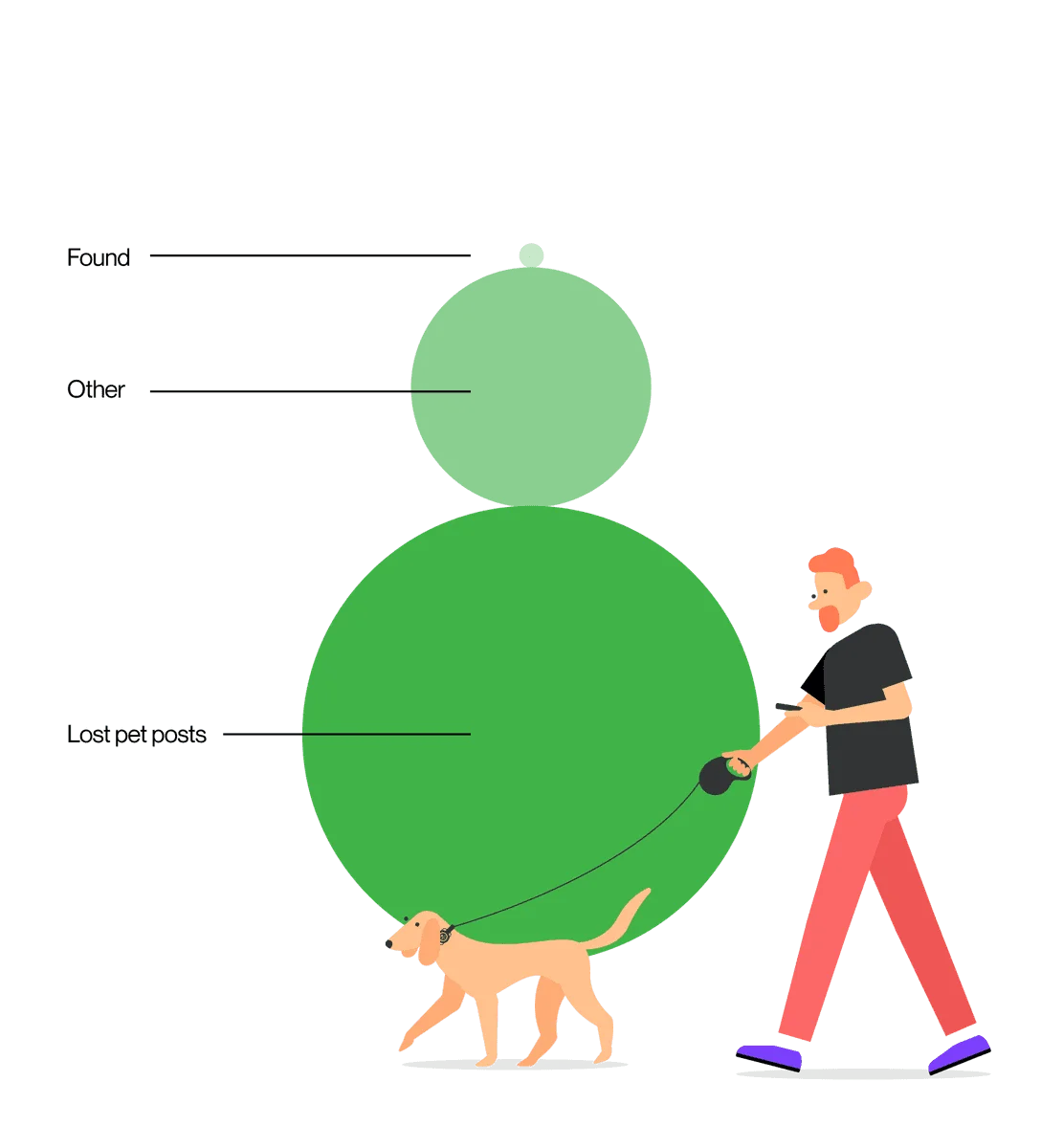
Three out of four feed posts showed someone losing their pet. Almost none showed them being found.
Pawscout is a Bluetooth pet tag and community app: owners attach a tag to their pet, and a mesh network of nearby Pawscout users helps locate lost ones.
The community feed was the core engagement surface, central to the company’s plan to grow toward external partners and advertisers. But the feed had become emotionally one-dimensional. Lost pet posts dominated visibility, while the product’s actual outcome, pets being found, happened invisibly, off-feed.
Engagement was declining, and with it, the business case for the next phase of the product.
I narrowed the brief from “build a new social feature” to “redesign two moments the product was already having.”
As Lead Product Designer, I owned the redesign of the post-resolution flow. The CEO had set engagement growth as the year’s strategic priority, needed to attract external advertisers and partners, and the initial direction was a new social feature.
After running user interviews and a community survey, I pushed back: the data showed users were already deeply emotionally invested in the existing lost pet journey. The highest-leverage move was to redesign the moments that were already happening at scale, not to add new surface area.

Don’t delete resolved posts. Transform them.
When a user marked their lost pet as found, the post used to disappear.
I redesigned this moment so that, at the user’s choice, the post could transform into a success story instead. A lightweight, celebratory version of itself, generated from the original report and surfaced to the same feed where the original loss had played out.
For unresolved cases, I designed a parallel flow that acknowledged the outcome with care and pointed users toward support resources, replacing what had previously been an abrupt dead end.
The feed stopped being a feed of loss. It became a feed of resolution.
The redesign shifted the emotional balance of the product: visibly, structurally, measurably. The community’s most positive content went from rare and manual to consistent and embedded in the flow.
Lost pet discoverability dropped slightly, a known trade-off we accepted, since the engagement gain on success content was disproportionately larger.
Reframing beats building.
Sometimes you don’t add a feature. You change what an existing one means. The most important lesson from this project was about leverage. When users are already emotionally invested in a flow, the highest-impact move is usually to redirect that energy, not to build something new beside it.
What I’d do differently next time: design the visual differentiation between post types from day one. We treated success stories as a transformation of an existing post: structurally elegant, but in practice the two types competed for the same visual attention, and lost pet posts lost a small share of discoverability we hadn’t fully modeled in advance.
The decision was still the right one, but the introduction would have been cleaner with explicit visual hierarchy from the start.
Higher engagement
vs standard lost posts
4x
Resolved lost pet posts
converted into success stories
2 of 3
Of feed composition (up from 1% previously, manually published)
26%
Next projects
See other case studies